









Five Hundred Issues with the S&P 500 — №500
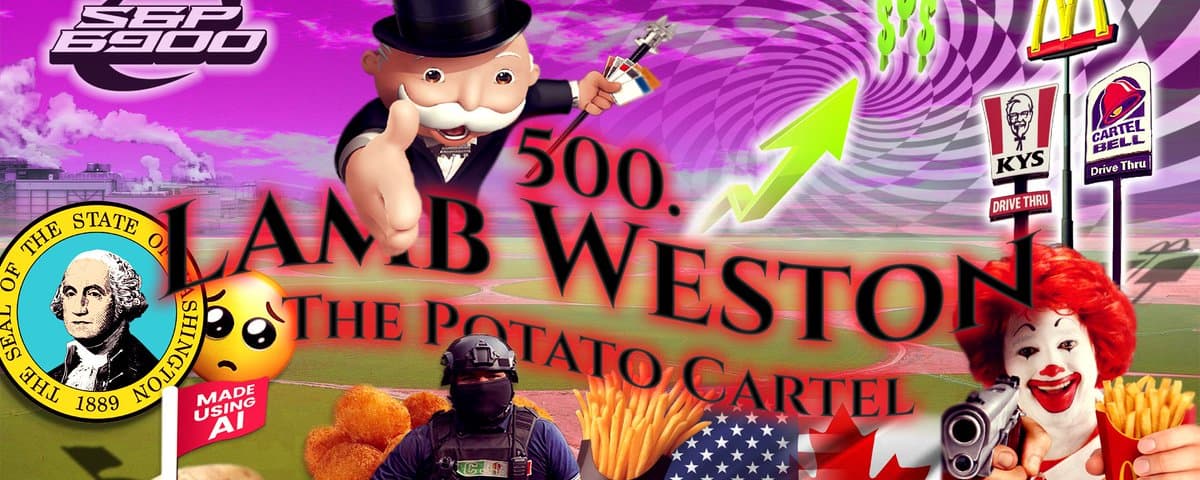
Lamb Weston Holdings, Inc. is an American food processing company known for its frozen potato products. Founded in 1950, Lamb Weston was added to the S&P 500 Index on December 3, 2018.
Weight in the S&P500: 0.01% Price/Share: ≈$43.33 Approximate Valuation: ∼ $5.7 billion
For Lamb Weston, restaurants and foodservice are the core business, accounting for approximately 70% of total revenue and profit. Retail customers make up a significantly smaller share, at roughly 15%.
The majority of foodservice revenue comes from large restaurant chains. McDonald’s alone accounts for an estimated 10–15% of consolidated net sales. [1] It is important to understand that for a food processing company of this scale, the interests of large restaurant chains will always outweigh those of retail customers. So is it really a surprise that during the pandemic, when the supply chains were broken and restaurants were shut down, it was the retail customer who ended up paying for it all?
Price-Fixing Allegations
The term "Potato Cartel" first appeared in headlines in late 2024, when initial complaints and rumours about an antitrust lawsuit began circulating. Going through those articles, I thought to myself that the using of the word "cartel" might be a bit excessive and it's probably just another journalist's trick to make you click on the article. But after digging deeper into the case, it turned out to be one of the most accurate depiction of the situation. A generalized definition of a cartel is "an association of manufacturers or suppliers with the purpose of maintaining prices at a high level and restricting competition." High concentration in the food processing industry is nothing new. Major food market players are trending toward oligopolies duopolies - the model of Coke and Pepsi. And the frozen potato industry has almost reached that state. Only four companies control the vast majority of the U.S. frozen potato market - ~95-97% of it.
Those four companies:
Lamb Weston ~40%
McCain Foods ~30%
J.R. Simplot ~20%
Cavendish Farms ~<10%
That level of control by four players, especially two main U.S. players (Lamb Weston, Simplot) plus two large global players (McCain, Cavendish) is typical of a highly concentrated oligopolistic industry. With so few competitors, coordinated behavior becomes significantly easier.
The pandemic put the industry to the test. The frozen potato industry was hit hard during the initial phase of the pandemic, especially on the foodservice side. Driven by massive, rapid, and widespread closure of restaurants and other foodservice establishments. As was mentioned before - the main consumer of the frozen potato products is restaurants - not retail customers. So, the moment restaurants were shutdown you have a broken supply chain with TONS of rotting storage potatoes in landfills. Some may have suggested shifting the focus toward the retail customer, maybe even go for lowering the prices to make the potato products more appealing towards the consumer. But it's not really how it works - the average consumer will not suddenly start buying frozen potatoes in volumes sufficient to replace 70–80% of total sales - certainly not in the short term. Shifting consumer preferences requires years of public campaigns (think Government Cheese or Whole Milk).
Instead, the frozen potato industry chose a different strategy: let the surplus rot and push higher prices onto the retail customer.
The graph for the PPI: Frozen Potato Products by the Federal Reserve Bank of St. Louis [2] looks frankly absurd.

Equally striking is the graph for the Average Price of potato chips of all types by the same institution.[3]

Of course those graphs alone don't signal industry-wide price-fixing. Many factors can affect the PPI that way: the rising cost of operation, the broken supply chain, the price increase of the raw product, etc.
But here it's hard to ignore another comparison: PPI for Frozen Fruit and Vegetable Manufacturing [4], it's a really similar industry with the same issues and difficulties.

The contrast is notable. After a similar (though smaller) pandemic-era spike, prices in frozen fruits declined in the second half of 2023, while prices in frozen potato products remained elevated. This discrepancy is one of the core allegations against Lamb Weston and the other three producers.
The complaints claimed that the price of the frozen potatoes remained high long after operating cost eased.
Again - the graphs itself are not the proof or cartel-like behavior. But in a highly concentrated market, where four firms control ~95% of production, under active cartel allegations, this pricing pattern becomes difficult to explain away.
The first lawsuits and news articles on the topic appeared in November, 2024. Within the first month more than a dozen coordinated private class action lawsuits were filled on behalf of small restaurants, grocery stores, and food distributors around the country.
In 2025, procedural consolidation dominated the case - complaints were consolidated and amended into set of three. Defendants filed a motion to dismiss the consolidated complaints on December 5, 2025.
As on the January 2026, the potato-cartel price fixing lawsuits are active but unresolved.
On October 6, 2025, plaintiffs filed three consolidated complaints on behalf of their putative classes, asserting amended claims against the Company, certain of our subsidiaries, other producers of frozen potato products, and a data provider. The consolidated complaints allege, among other things, that beginning at least as early as January 1, 2021, the defendants conspired to raise the price of frozen potato products above competitive levels in violation of U.S. antitrust laws by coordinating prices of frozen potato products and imposing lockstep price increases, allegedly facilitated by the exchange of non-public information about prices and production. The complaints on behalf of the putative classes of indirect purchasers also assert claims under various state laws, including state antitrust laws, unfair competition laws, and consumer protection statutes. The relief sought in the complaints includes treble damages, injunctive relief, equitable monetary relief, pre- and post-judgment interest, costs and attorneys’ fees. On December 5, 2025, defendants filed a motion to dismiss. Briefing is ongoing and the motion remains pending. Class actions based on similar allegations have also been filed in Canada, in the Supreme Court of British Columbia and the Superior Court of Quebec. We believe these complaints lack merit and intend to vigorously defend against the allegations. We are currently unable to predict the outcome of this matter or estimate the range of potential loss, if any, that may result. - From Lamb Weston's SEC Filling [5]
Multiple investigative articles have been published in both the U.S. and Canada. I personally would recommend The Lever's reporting on the topic [6].
More about Lamb Weston
The potato cartel lawsuit is not the only legal issue Lamb Weston has faced over the years.
In the early 2025, Lamb Weston workers in the state of Washington filled a class action lawsuit claiming the company failed to provide proper breaks, seeking $14 million in damages. [8]
In the 2022, Lamb Weston was fined for laughable $127,000 for multiple cases of nitrogen pollution. [9]
P.S. Learning more about the companies in the S&P500 I've noticed a funny (at least to me) desperate attempt to appear "HIP", "MODERN" and "ON THE CUTTING EDGE". Today, that means AI. Lamb Weston is implementing AI to their business as well and they're very proud of it. [10]
That's it for Lamb Weston Inc. - one of the five hundred companies composing the S&P 500.

This article is not financial advice and not an investment thesis.
I'm not a professional journalist and do not aim to be one. I don't seek to be a reliable source.
The text is based on publicly available information that can be found online. It's intentionally biased but documentable.
This is anti-corporate pamphlet - deliberate reputational vandalism created for cultural critique and entertainment.
The goal is to dismantle the myth of the S&P 500 by inspecting every company that composes it.
Look into SPX6900.
Flip the stock market.
6900>500.